
Chair for Elevators: Safe, Space-Saving Seating Guide
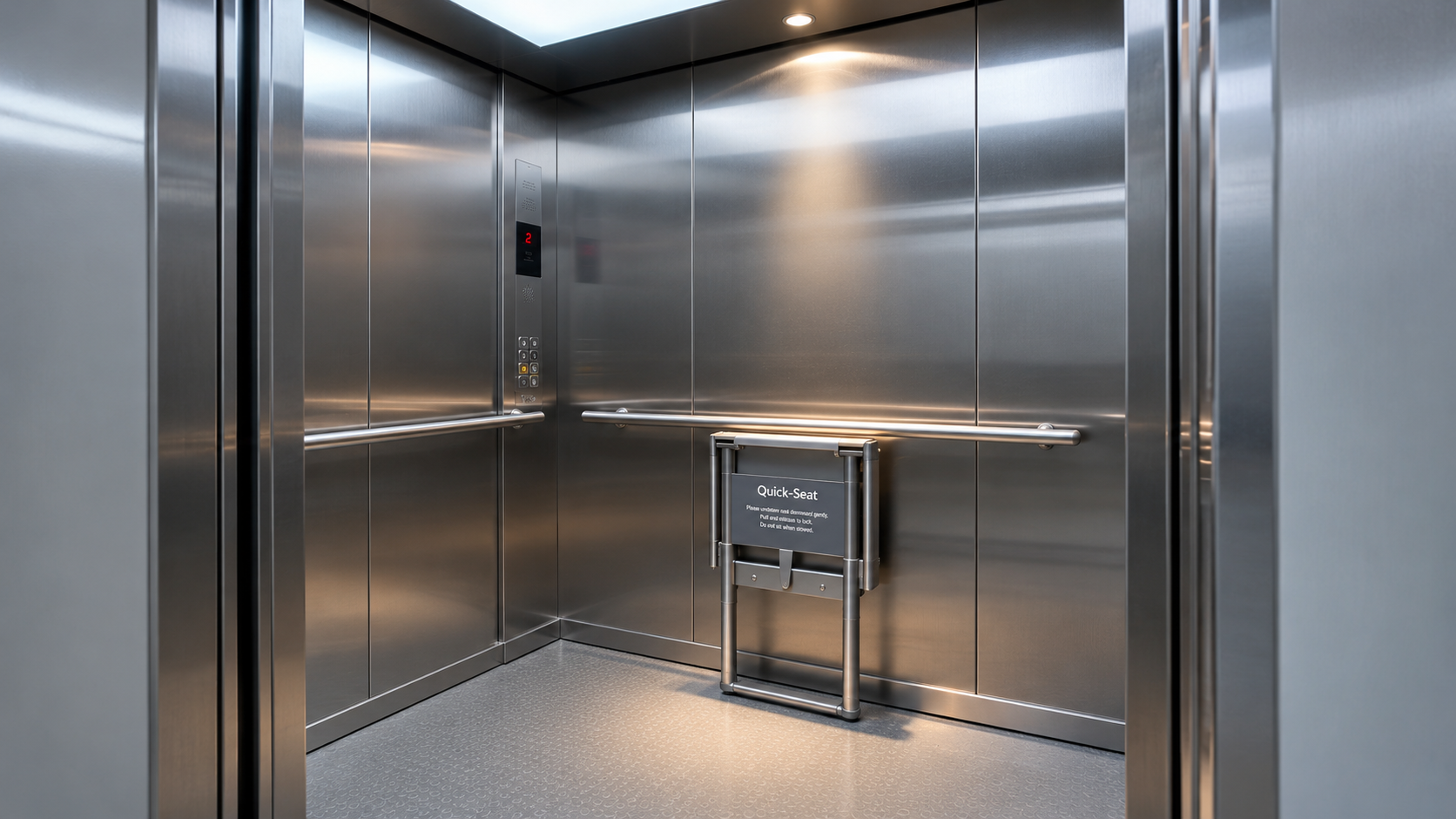
Chair for Elevators: The Complete Guide to Safe and ADA-Compliant Seating
An elevator ride may last only a few minutes, but standing can be difficult for seniors, patients, people with limited mobility, and passengers who feel fatigued.
The challenge for building owners is simple: How can you provide a place to sit without taking up valuable elevator floor space?
A wall-mounted, fold-down stool offers a practical option. It provides temporary seating when needed and folds away afterward, helping keep the elevator available for other passengers and mobility equipment.
For facility managers, architects, healthcare administrators, and commercial property owners, choosing the right chair for elevators requires more than comparing designs. Space, accessibility, installation conditions, durability, and applicable building requirements all matter.
Why Do Commercial Elevators Need Space-Saving Seating?
Commercial elevators serve people with different mobility needs throughout the day. A passenger may use a wheelchair, another may walk with a cane, and someone else may be carrying luggage or equipment.
A conventional chair can create a problem in this confined environment. It occupies floor space even when nobody is using it.
A wall-mounted folding seat approaches the problem differently. Instead of sitting permanently on the elevator floor, it attaches to the wall and folds toward it when not in use.
This design offers two practical advantages:
- Temporary seating: Passengers have a place to sit when standing is difficult.
- More available floor space: The seat can fold away when it is not needed.
For buildings with frequent passenger traffic, the goal is to balance useful seating with unobstructed movement.
Are Folding Elevator Seats ADA-Compliant?
Accessibility is a critical consideration when selecting elevator seating in the United States.
However, a product should not automatically be described as ADA-compliant simply because it folds against a wall or saves space. Compliance depends on the applicable requirements and the specific installation.
Before installing a seat, building owners and facility managers should consider:
- Available floor area and passenger circulation.
- Wheelchair and other mobility-device access.
- Elevator door clearances and movement around the seat.
- Wall construction and mounting requirements.
- Applicable ADA provisions, elevator codes, building codes, and local regulations.
The Americans with Disabilities Act establishes accessibility requirements for covered facilities. Whether a proposed elevator seating arrangement meets those requirements must be assessed in context.
Consult a qualified accessibility professional or the relevant authority when necessary. Confirm that the proposed installation does not compromise required clearances or accessible use.
The key principle: Space-saving seating should support passenger needs without creating a new accessibility barrier.
Why Traditional Chairs Can Be a Poor Fit for Elevators
A chair that works well in a lobby or waiting room may not work well inside an elevator.
Permanent chairs occupy floor space
A conventional chair remains in the way even when nobody is sitting on it. In a compact elevator, that can affect how passengers move and position mobility equipment.
Portable chairs require handling and storage
A portable seat must be brought into the elevator, positioned, and removed or stored after use. This creates additional work for staff and may make seating unavailable when it is needed.
Fixed benches take up more room
A bench may accommodate multiple people, but it also requires more space and may be impractical for smaller elevator interiors.
A properly planned wall-mounted folding seat offers another approach: keep seating available without permanently dedicating the same floor area to furniture.
How the Quick-Seat Wall Folding Stool Works
The Quick-Seat Wall Folding Stool is designed to provide temporary seating in commercial environments without requiring a conventional floor-standing chair.
Its wall-mounted design keeps the stool attached to the elevator wall. When a passenger needs a seat, it can be lowered. After use, its self-closing action returns it toward the folded position.
This mechanism addresses a practical facilities-management concern: seating should be available when needed but should not remain extended unnecessarily.
For building operators, the value lies in the combination of accessible placement, compact storage, and straightforward operation.
As with any wall-mounted fixture, the suitability of the product depends on the elevator layout, mounting conditions, intended use, and applicable requirements. These should be evaluated before installation.
Key Benefits of Wall-Mounted Elevator Seating
1. Better use of limited space
A folding seat provides temporary seating while allowing the floor area to remain available when the seat is folded away.
This is particularly relevant to elevators that carry passengers with wheelchairs, walkers, carts, luggage, or other equipment.
2. Convenient access to seating
A fixed installation eliminates the need to locate and move a portable chair each time someone needs a place to sit.
3. Self-closing operation
The Quick-Seat design returns toward its folded position after use. This helps reduce the chance of the seat being left extended unnecessarily.
4. Practical day-to-day maintenance
A wall-mounted seat avoids the need to move portable furniture during routine floor cleaning. Facilities teams should still follow the manufacturer’s cleaning and inspection instructions.
5. Suitability for commercial environments
Elevator seating may be worth evaluating in healthcare facilities, senior living communities, hotels, office buildings, airports, universities, and other public or commercial buildings.
The appropriate solution will depend on each building’s passenger needs and physical constraints.
Where Can an Elevator Folding Seat Be Used?
A compact elevator seat may be useful in settings where passengers could benefit from a brief resting place.
Examples include:
- Hospitals and medical centers: Patients and visitors may need temporary seating between destinations.
- Senior living and rehabilitation facilities: Some passengers may find standing for an elevator ride difficult.
- Hotels and office buildings: Visitors and employees may appreciate convenient seating.
- Airports and transportation facilities: Passengers may be tired or carrying luggage.
- Universities and government buildings: High-traffic facilities may need to balance passenger flow with practical seating options.
These are potential applications, not a guarantee that every elevator is suitable for installation.
What Should Facility Managers Check Before Installation?
Before choosing a chair for an elevator, evaluate the following factors.
1. Elevator dimensions: Confirm that the seat fits the available wall area and does not create an obstruction.
2. Passenger movement: Consider how people enter, exit, turn, and position mobility devices.
3. Accessibility and code requirements: Have the proposed layout assessed against applicable federal, state, and local requirements.
4. Mounting conditions: Confirm that the wall and mounting arrangement can support the intended installation.
5. Product operation: Understand how the seat opens, folds, and behaves during ordinary use.
6. Maintenance requirements: Review cleaning procedures, inspection needs, and the manufacturer’s product documentation.
Making these checks before purchase can help prevent costly installation changes and reduce the risk of selecting an unsuitable fixture.
Is a Wall-Mounted Folding Seat the Right Choice?
A wall-mounted folding seat is worth considering when an elevator needs temporary seating but has limited room for conventional furniture.
It may be less suitable where the wall cannot accommodate the mounting arrangement, passenger circulation would be affected, or the proposed installation cannot meet applicable requirements.
The decision should be based on the elevator’s actual layout and intended use, not simply on the smallest product footprint.
For facilities that meet the necessary conditions, the Quick-Seat Wall Folding Stool offers a compact alternative to floor-standing seating.
Explore a Space-Saving Seating Solution for Your Building
Providing elevator seating does not have to mean permanently giving up valuable floor space. A well-planned wall-mounted folding stool can make temporary seating available while keeping the area more open when the seat is not in use.
If you manage a commercial building, healthcare facility, or other high-traffic property, review the Quick-Seat Wall Folding Stool as a potential solution for your elevator seating needs.
Visit Quick-Seat to explore the product and determine whether it fits your facility’s requirements. Confirm dimensions, installation conditions, and applicable accessibility requirements before proceeding.