
The Best Folding Chair for Hospitals in the USA: Space Saving Hospital Seating Solution
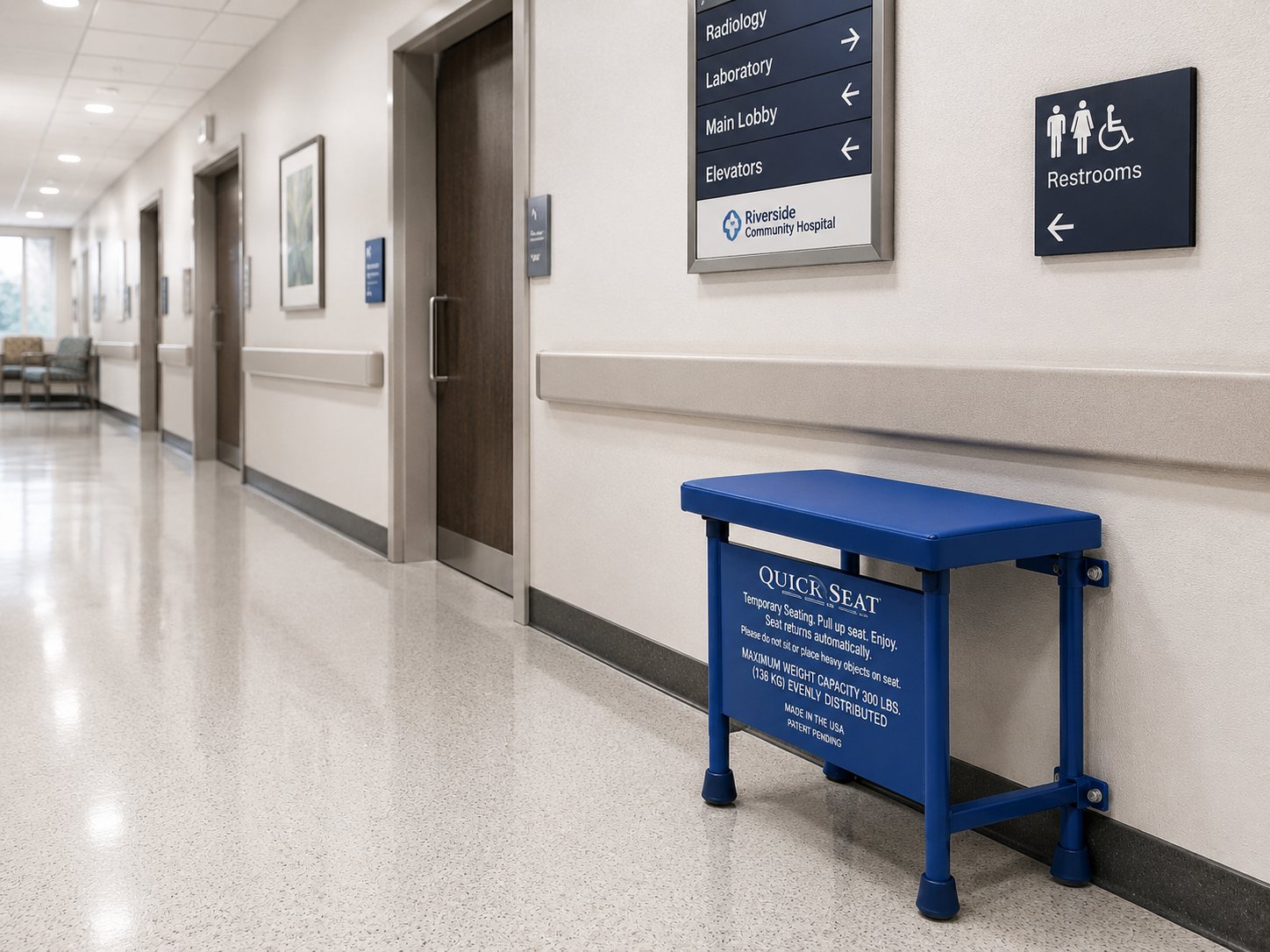
America’s leading hospitals , from Mayo Clinic in Rochester to Johns Hopkins in Baltimore, Cleveland Clinic in Ohio to NYU Langone in New York City , share one thing beyond clinical excellence: every square foot of their facilities is engineered to work harder than the one beside it.
Seating is no exception.
As hospitals across the United States renovate aging wings and construct new facilities, architects and facility planners are rethinking one of the most overlooked elements of healthcare design: where patients sit when they’re not in a room.
The answer is no longer a row of fixed chairs bolted to a corridor wall. It’s a wall mounted folding chair — available the instant it’s needed, completely out of the way when it’s not.
The Quick-Seat Wall Folding Chair was built precisely for this purpose: a commercial-grade, self-retracting folding chair for hospitals that maximizes floor space, supports ADA compliance, and holds up to the demanding pace of American healthcare environments.
Why American Hospitals Are Rethinking Their Seating Strategy
The U.S. healthcare infrastructure is in the middle of one of its largest modernization cycles in decades. <cite index=”16-1″>The medical chairs market was valued at $8.90 billion in 2025 and is projected to reach $9.33 billion in 2026</cite>, with facility planners across the country re-evaluating every piece of furniture that touches a patient’s experience.
The shift is driven by a simple reality: traditional seating was designed for a hospital model that no longer exists.
Today’s facilities are decentralized. Patients move between oncology suites, imaging departments, rehabilitation wings, lab collection centers, and outpatient clinics — often waiting briefly in corridors, elevator lobbies, and departmental hallways that were never designed with seating in mind.
That gap — between where patients actually wait and where chairs have historically been placed — is exactly where a space saving chair for hospital environments solves a real operational problem.
Every Square Foot Costs Real Money
Hospital construction in the United States is among the most expensive building programs in any sector. Interior space is both limited and costly, which means every furnishing decision carries a financial dimension that goes well beyond purchase price.
Busy hospital corridors must accommodate patients, visitors, physicians, nurses, wheelchairs, stretchers, medication carts, diagnostic equipment, environmental services staff, and emergency response teams — all moving simultaneously.
A fixed chair that sits empty 80% of the day isn’t just wasted furniture. It’s wasted space. In a facility where corridor width affects code compliance, equipment access, and emergency response times, permanent seating that isn’t consistently used becomes an active liability.
A wall mounted folding chair eliminates this trade-off entirely. It provides a seat when someone needs one — and disappears back into the wall the moment they stand up.
This is the core principle behind Quick-Seat®: genuine space efficiency without compromising patient comfort.
Where Patients Actually Need to Sit
The traditional hospital waiting room covers only a fraction of the locations where patients pause during a visit. Understanding where people actually stop — and why — is the foundation of smarter healthcare seating solutions.
Consider the typical patient journey through a major American medical center:
Diagnostic Imaging Departments Patients scheduled for MRI, CT, ultrasound, or X-ray often arrive early and wait outside the department. These corridors are typically narrow and high-traffic. A folding chair for hospitals mounted on the wall provides rest without creating an obstruction for equipment or staff.
Oncology and Infusion Centers Treatment schedules in cancer care are rarely predictable to the minute. Patients — many of whom are physically depleted — frequently wait in hallways between appointments. Strategic placement of a hospital waiting room chair along these corridors is a direct quality-of-care decision.
Elevator Lobbies This is one of the most consistently overlooked seating locations in American hospitals. Elevator lobbies in multi-story facilities like Houston Methodist, UCSF Medical Center, and Northwestern Memorial Hospital see continuous foot traffic throughout the day. A folding stool for elevators — mounted flush on the lobby wall — gives patients, seniors, and visitors a place to rest during what can be a several-minute wait, without permanently reducing the clearance of a busy transition zone.
Rehabilitation and Physical Therapy Wings Patients in active recovery programs experience fatigue that is often unpredictable. A space saving chair for hospital corridors near therapy rooms means patients can rest between exercises without navigating to a distant waiting area.
Outpatient Clinics and Specialty Departments Cardiology, neurology, orthopedics, and behavioral health clinics all operate on appointment schedules that create natural queuing outside department doors. A wall mounted folding chair positioned beside each entry point turns dead corridor space into a functional patient amenity.
Laboratory Collection Centers Blood draw and lab collection areas generate short, unpredictable waits. A folding chair for hospitals in these areas directly reduces patient frustration and perceived wait time.
Pharmacy Pickup Locations Patients who have just been discharged or are completing outpatient treatment often wait at pharmacy counters while prescriptions are filled. Seating in these locations is among the highest-impact placements in any facility.
The Problem with Conventional Hospital Seating
Many American hospitals are still operating with furniture purchased under a completely different philosophy — one that prioritized permanence over flexibility.
Fixed Seating Permanent chairs occupy floor space every hour of every day, regardless of whether anyone is using them. They create ongoing obstacles for equipment movement, restrict layout flexibility, and complicate renovation projects. In departments that frequently reconfigure, fixed seating is a recurring friction point.
Portable Chairs Movable chairs introduce a staffing burden. Someone must retrieve them, position them correctly, and return them to storage. In a high-pressure clinical environment, portable furniture inevitably ends up in the wrong place — blocking a corridor, cluttering a storage room, or simply going missing.
Benches Multi-seat benches require a significant floor footprint and offer very little flexibility. They cannot be repositioned easily, they complicate housekeeping, and they tend to dominate narrow corridors in a way that creates both aesthetic and operational problems.
The better answer — increasingly adopted by healthcare seating solutions specialists and facility planners at major American health systems — is a wall mounted folding chair that removes the trade-off between availability and space efficiency.
Quick-Seat: The Folding Chair for Hospitals Built for American Healthcare
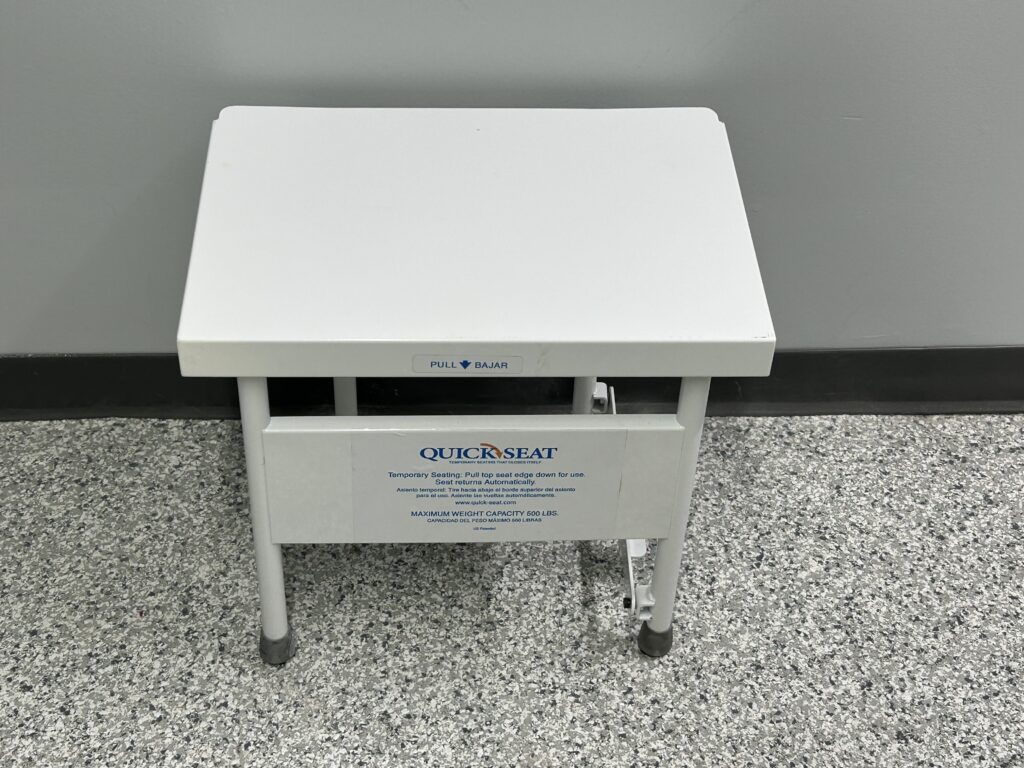
The Quick-Seat® Wall Folding Chair was engineered specifically for the demands of high-traffic institutional environments. It is not a residential fold-down seat repurposed for commercial use — it is a purpose-built space saving chair for hospital corridors, clinics, and public areas.
Here is what separates it from every alternative.
Permanently Mounted. Always Ready.
Unlike a portable folding chair for hospitals that requires setup and storage, Quick-Seat is fixed directly to the wall. It is there when a patient needs it. It is out of the way when no one does. No staff involvement. No storage logistics. No misplaced chairs.
Self-Retracting After Every Use
This is the feature that makes Quick-Seat genuinely different from any standard wall mounted folding chair on the market.
After a user stands up, the seat automatically returns to its upright, flat position against the wall. The corridor stays clear. The chair stays ready. No one has to fold it back manually — which means it will always be in the right position for the next person who needs it.
In a busy hospital corridor, this single feature eliminates a persistent housekeeping and operational nuisance while keeping hallways consistently unobstructed.
Commercial-Grade Construction
The Quick-Seat is built to perform in the same environments as the facilities it serves. Commercial-grade materials and engineering mean it withstands the kind of continuous, high-frequency use that major American hospitals demand — without the maintenance burden or replacement cycles of lighter-duty alternatives.
<cite index=”18-1″>Facilities managers and procurement teams outfitting a healthcare facility know that furniture decisions impact far more than aesthetics — the right seating must stand up to stringent cleaning protocols and heavy wear across continuous daily use.</cite> Quick-Seat is designed to exactly that standard.
Simple Enough for Every Patient
A hospital waiting room chair serves an exceptionally diverse population — elderly patients, post-surgical patients, patients with limited grip strength or mobility, and visitors of all ages and physical conditions.
Quick-Seat’s fold-down operation requires no mechanical knowledge, no strength, and no instruction. Pull it down to sit. Stand up and it returns on its own. That simplicity is not incidental — it is a deliberate design priority.
Easy to Clean and Maintain
Infection control is among the highest priorities in any American healthcare environment. Quick-Seat’s streamlined surfaces allow environmental services teams to wipe down efficiently using standard healthcare disinfectants. Because it is wall-mounted, housekeeping staff can clean the floor area beneath it without moving or repositioning any furniture — a consistent time-saver across a large facility.
10 Reasons American Hospitals Choose Quick-Seat
1. Maximizes Floor Space The defining advantage of any space saving chair for hospital environments: Quick-Seat occupies zero floor space when not in use.
2. Supports ADA Compliance By keeping corridors clear when folded, Quick-Seat helps maintain accessible pathways for patients using wheelchairs, walkers, and mobility devices — a critical compliance consideration in every American healthcare facility.
3. Improves the Patient Experience <cite index=”39-1″>Hospital waiting room chairs show consistent and significant search interest, with notable peaks corresponding to hospital expansion cycles</cite> — because patient comfort is a documented quality metric. Convenient seating, placed where patients actually pause, directly improves satisfaction scores.
4. Self-Retracting Mechanism Corridors stay clear automatically. No staff required. No manual folding. Consistent performance every time.
5. Supports Better Traffic Flow Open corridors improve movement for patients, staff, and medical equipment — a measurable operational benefit in high-volume facilities.
6. Simplifies Housekeeping Floor cleaning is faster and easier when furniture is mounted to the wall rather than sitting on the floor.
7. Built for Heavy Daily Use Commercial-grade engineering delivers reliable performance in the most demanding American healthcare environments.
8. Enhances Facility Appearance A neatly folded wall mounted folding chair contributes to a cleaner, more organized visual environment — consistent with the standards of leading American health systems.
9. Supports Long-Term Facility Planning Flexible seating adapts to departmental reorganizations and renovations without requiring new procurement or installation.
10. Strong Return on Investment Long service life, minimal maintenance, and no storage requirements make Quick-Seat one of the most cost-effective healthcare seating solutions available to American hospitals.
Ideal Installation Locations Across American Healthcare Facilities
The Quick-Seat® folding chair for hospitals performs exceptionally well across every area where patients and visitors pause during a hospital visit.
Emergency Departments — Immediate seating for patients and visitors without creating permanent congestion in one of a hospital’s highest-traffic zones.
Hospital Corridors — The primary application. A wall mounted folding chair placed every 50–75 feet along major corridors transforms the patient experience across an entire building.
Elevator Lobbies — A folding stool for elevators or full folding chair mounted beside lift banks serves one of the busiest transition points in any multi-story hospital. Facilities like Mayo Clinic in Rochester and Massachusetts General Hospital in Boston manage thousands of elevator rides per day — a well-placed seat beside every bank is a meaningful patient amenity.
Outpatient Clinics — Where appointment schedules create natural queuing outside department doors.
Diagnostic Imaging — Outside MRI, CT, X-ray, and ultrasound suites where patients frequently wait with little to no seating nearby.
Oncology and Infusion Centers — Where physically vulnerable patients most benefit from convenient, immediate seating.
Rehabilitation Facilities — Resting points that support patients in active therapy programs without requiring them to return to a designated waiting area.
Dialysis Clinics — Additional seating that improves patient comfort while maintaining open circulation.
Long-Term Care and Skilled Nursing Facilities — Accessible seating throughout resident corridors and common spaces.
Beyond Hospitals: Where Quick-Seat Adds Value
The same engineering that makes Quick-Seat the ideal space saving chair for hospital environments makes it equally effective in:
- Airport terminals and transit stations
- University campuses and student health centers
- Federal and government buildings
- Public libraries
- Corporate campuses
- Shopping centers
- Research and laboratory facilities
- Elevator lobbies in office towers and residential buildings
Wherever foot traffic is high, space is limited, and permanent furniture is impractical, a wall mounted folding chair is the intelligent solution.
How to Choose the Right Folding Chair for Hospitals in the USA
Not every folding chair for hospitals is engineered for the demands of American healthcare. Before specifying a wall-mounted seating solution, facility planners should evaluate these criteria:
Commercial-Grade Construction Residential or light-commercial fold-down seats are not appropriate for hospital environments. Specify products built and tested for institutional, high-frequency use.
Self-Retracting Mechanism Manual fold-up chairs create operational and housekeeping friction. A self-retracting mechanism ensures corridors remain clear without staff involvement.
ADA Considerations The chair should fold flat enough against the wall to maintain compliant pathway widths when not in use. Verify clearance dimensions against current ADA Standards for Accessible Design.
Infection Control Compatibility Surface materials must be compatible with EPA-registered healthcare disinfectants and cleanable with standard hospital housekeeping protocols.
Ease of Operation The hospital waiting room chair must be operable by patients of all ages and physical abilities without assistance or instruction.
Installation Requirements Verify load-bearing wall requirements and mounting specifications. Quick-Seat includes full installation documentation for facility engineering teams.
Lifecycle Cost The lowest unit price is rarely the lowest total cost. A commercial-grade wall mounted folding chair with a long service life and minimal maintenance will consistently outperform cheaper alternatives over a five-to-ten-year horizon.
Supporting the Future of American Healthcare Design
<cite index=”16-1″>Hospital facility renovation cycles and the expansion of ambulatory care delivery models are creating procurement requirements for specialized seating across clinical settings throughout the United States.</cite>
The direction is clear: American hospitals are moving away from centralized waiting rooms and toward distributed, patient-centered environments where comfort is delivered at the point of need — not redirected to a distant lobby.
<cite index=”40-1″>Given the recurring theme for adaptable spaces, modular and flexible furniture systems are growing in adoption, allowing facilities to easily adapt to changing needs and optimize space utilization.</cite>
Wall-mounted folding chairs and folding stools are a foundational component of this shift — small in footprint, significant in impact.
As facilities like Johns Hopkins, Cleveland Clinic, NYU Langone, and UCSF Medical Center continue to set the standard for American healthcare design, the furniture choices that support their environments deserve the same rigor applied to every other clinical decision.
Frequently Asked Questions
What is the best folding chair for hospitals in the USA? The best folding chair for hospitals in the USA is wall-mounted, self-retracting, ADA-aware, and built to commercial grade. The Quick-Seat® Wall Folding Chair meets all of these requirements — it is permanently mounted, requires no manual folding after use, and is engineered specifically for high-traffic institutional environments.
What is a wall mounted folding chair used for in hospitals? A wall mounted folding chair provides immediate seating in hospital corridors, outpatient clinics, elevator lobbies, and departmental hallways — locations where patients frequently pause but permanent furniture is impractical. It folds flat against the wall when not in use, preserving corridor clearance and ADA-compliant pathways.
Why is a space saving chair important in hospital design? In American hospitals, interior space is expensive and every square foot must serve a functional purpose. A space saving chair for hospital environments provides patient comfort on demand without permanently occupying valuable floor space that is needed for equipment movement, staff circulation, and emergency access.
What makes Quick-Seat different from a standard hospital waiting room chair? A standard hospital waiting room chair is freestanding and occupies floor space continuously. Quick-Seat® is wall-mounted, self-retracting, and available only when someone needs it — which means it provides the same comfort with zero permanent floor footprint and no staff involvement in maintaining corridor order.
Can a folding stool be used near hospital elevators? Yes. A folding stool for elevators — or a full Quick-Seat® wall mounted folding chair — installed beside elevator banks is one of the highest-impact placements in any multi-story hospital. It serves patients, visitors, and elderly individuals who may wait several minutes for a lift, and folds completely flat when not in use.
Are Quick-Seat® folding chairs suitable for major American hospital systems? Yes. Quick-Seat® is engineered to the commercial and institutional standards required by major American health systems, including multi-site hospital networks, academic medical centers, and ambulatory care facilities. Its self-retracting mechanism, commercial-grade construction, and ADA-conscious design make it appropriate for deployment across any scale of healthcare facility.
How do Quick-Seat folding chairs support healthcare seating solutions at scale? For large health systems managing dozens of departments across multiple buildings, Quick-Seat® offers a standardized, low-maintenance healthcare seating solution that can be deployed consistently across every corridor, lobby, and clinical area — reducing procurement complexity and delivering a unified patient experience throughout the facility.
Final Thoughts
Great hospital design is not only about clinical spaces. It is about the entire patient journey — including every moment spent moving between appointments, waiting beside an elevator, or pausing outside a treatment room.
A thoughtfully placed folding chair for hospitals addresses one of the most basic human needs in one of the most complex environments in the world: a place to sit, right where you need it.
The Quick-Seat® Wall Folding Chair delivers exactly that — dependable seating available the moment it is needed, invisible the moment it is not, and built to perform through years of demanding American healthcare use.
For facility planners designing the next generation of American hospitals, healthcare seating solutions that combine flexibility, durability, and genuine space efficiency are no longer optional — they are foundational.
Quick-Seat® is that solution.
Ready to Specify Quick-Seat for Your Facility?
Whether you are planning a new healthcare facility, renovating an existing hospital wing, or upgrading corridor seating across an outpatient network, the right folding chair for hospitals can make a measurable difference in patient experience, staff efficiency, and operational performance.
Contact the Quick-Seat team today to request product specifications, installation documentation, or to discuss your facility’s seating requirements with our team.
Quick Reference: Quick-Seat at a Glance
- ✅ Best folding chair for hospitals in the USA — commercial grade, purpose-built
- ✅ Self-retracting after every use — corridors stay clear automatically
- ✅ Wall mounted folding chair — zero permanent floor footprint
- ✅ ADA-conscious design — helps maintain compliant pathway widths
- ✅ The smart space saving chair for hospital corridors, lobbies, and clinics
- ✅ Ideal folding stool for elevators and high-traffic transition zones
- ✅ Easy to clean — compatible with hospital-grade disinfectants
- ✅ Commercial-grade durability for heavy daily use
- ✅ Proven healthcare seating solution for American health systems
- ✅ Designed for years of dependable, low-maintenance service
Published on quick-seat.com | © Quick-Seat® | America’s Wall-Mounted Folding Chair for Hospitals and Healthcare Facilities